
A Comprehensive Look at the Huawei P50 Pro Performance
 Saroj Yadav
The Phone That Shouldn't Exist — But Does, and It's Brilliant

Look, Huawei had a terrible few years. No Google. No 5G. And yet somehow they built one of the best cameras I've ever tested. That's either genius or stubbornness. Probably both.
This review of the Huawei P50 Pro is my honest take — no sugarcoating the Google problem, no pretending the 4G limitation doesn't sting in 2026. Just a straight answer to one question: is this phone still worth your money?
Here's the short version before we go deep.
| Category | Quick Verdict |
|---|---|
| Camera | Outstanding — top-ranked in professional imaging benchmarks with a score of 143 |
| Display | Excellent 6.6-inch 120Hz OLED, sharp and vibrant |
| Performance | Strong Snapdragon 888, but throttles under sustained load |
| Battery | Decent ~9 hours, with impressively fast 66W wired charging |
| Software | Functional but limited — no Google services, no 5G |
| Best For | Photography lovers and existing Huawei ecosystem users |
| Avoid If | You rely on Google apps, banking apps, or need 5G |
I'm Saroj Yadav, a tech journalist at TechXomos covering smartphones, gadgets, and AI for Indian consumers. I've tested flagships across every price range — and the P50 Pro is one of the more complicated ones to call.
Is the Camera Actually Worth It?
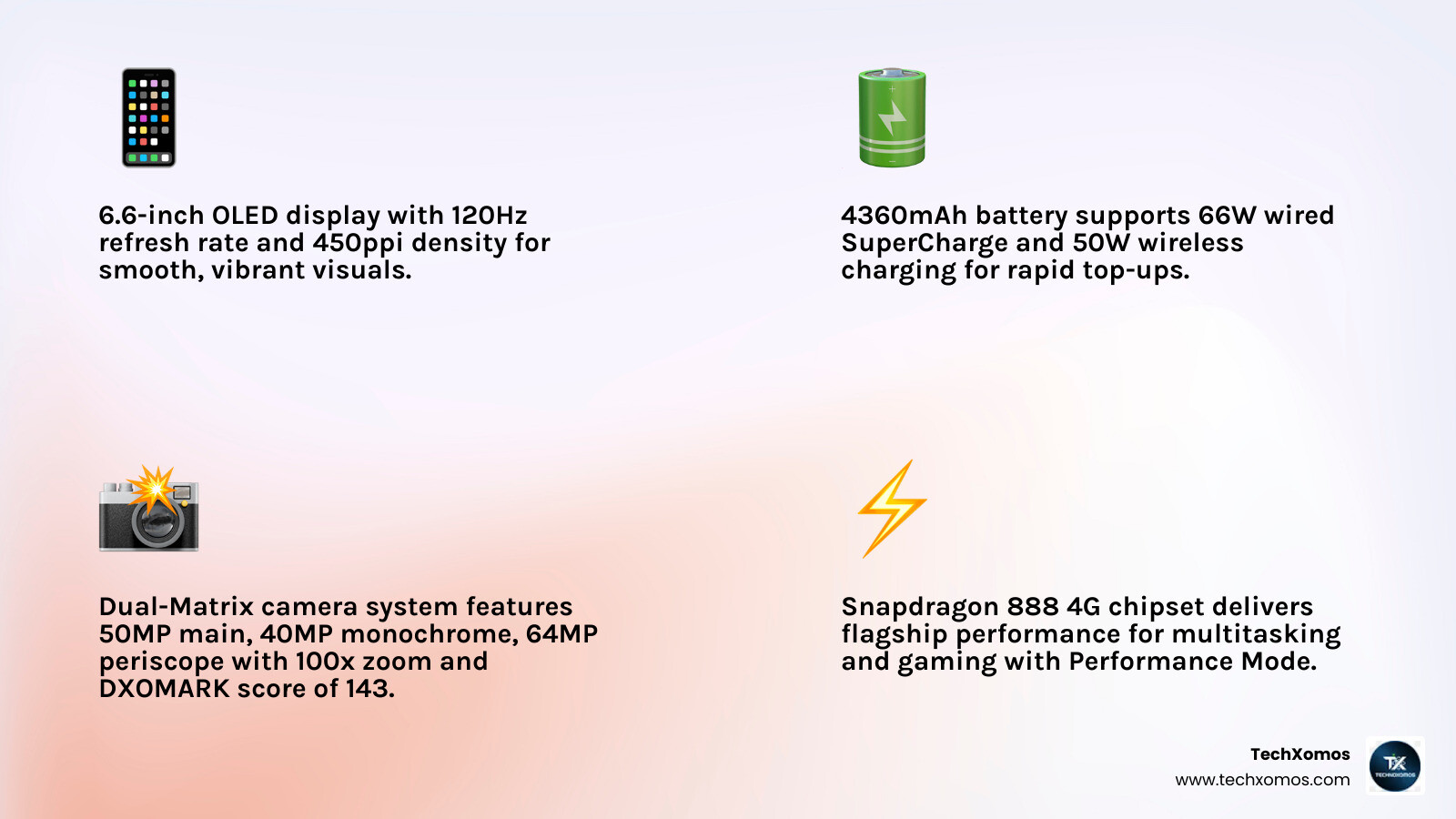
Short answer: yes. Longer answer: it's not just worth it — it's embarrassingly good for a phone that technically has "no Google." The P50 Pro scored 143 on DXOMARK when it launched, which was a new record at the time. That kind of lead doesn't disappear overnight.
Huawei introduced two things here that actually matter: XD Optics and the True-Chroma Image Engine. The True-Chroma system uses a 10-channel multi-spectrum sensor to read ambient light in a way standard sensors simply can't. The result is white balance that looks natural — not the "processed" look you get from most phone cameras.
Detailed benchmark data from DXOMARK's Huawei P50 Pro camera review backs all of this up with hard numbers.

What Are the Four Cameras Actually Doing?
The setup here is not just "more sensors for the sake of it." Each lens has a real job, and they work together rather than independently.
| Sensor Type | Resolution | Aperture | Key Feature |
|---|---|---|---|
| Main (True-Chroma) | 50MP | f/1.8 | OIS, Laser AF, XD Fusion Pro |
| Monochrome | 40MP | f/1.6 | High detail, low noise |
| Ultra-Wide | 13MP | f/2.2 | 13mm equivalent, Autofocus |
| Telephoto (Periscope) | 64MP | f/3.5 | 3.5x Optical, 100x Digital, OIS |
The 40MP monochrome sensor is the one that genuinely surprised me. I expected it to be a gimmick — a spec sheet number that nobody actually uses. I was wrong. It pairs with the main 50MP sensor to pull in more light and sharpen fine texture, especially at night. Portrait shots in dim light looked noticeably better than I expected.
Zoom is another story worth telling. The 64MP telephoto allows for clean "lossless" cropping up to 7x, and even at 10x images stay sharp enough to share without embarrassment. The 100x digital zoom exists if you want it — honestly, it's more of a party trick than a practical tool, but it does work. Independent testing scored the zoom at 107 in its sub-category, which is not a number you can fake.
My one complaint about the cameras? The ultra-wide at 13MP feels like an afterthought next to the other three sensors. It gets the job done, but the quality gap is visible if you compare shots side by side.
Does the Screen Hold Up in Daily Use?
The 6.6-inch OLED curved display is one of those things that makes you forget the software problems for a few minutes. It runs at 120Hz, has a 300Hz touch sampling rate, and uses 1440Hz High-frequency PWM dimming — which sounds like marketing until your eyes stop hurting after two hours of late-night scrolling.
At 450ppi, text is sharp enough that I genuinely stopped noticing pixels. The curved edges look beautiful, though I'll admit they catch reflections in bright sunlight more than I'd like. That's the trade-off for the premium look.
Build quality is proper flagship — front and back glass curving into an aluminum frame, IP68 water resistance, and at 195g it's actually lighter than the P40 Pro. One real-world warning though: the Cocoa Gold and Golden Black finishes are fingerprint magnets. Use the included case or accept a permanent smudge situation.
How Does It Actually Perform Under Pressure?
Day-to-day, the Snapdragon 888 4G is fast. Switching between apps, editing photos, watching video — all smooth. The "4G" label next to the chipset name is purely a trade restriction consequence, not a performance issue.
Gaming is where things get complicated. During 45-minute sessions of Genshin Impact or Call of Duty Mobile, the phone gets noticeably warm and starts to throttle. Huawei's "Performance Mode" in settings helps stabilize frame rates but increases heat. Most users won't hit this wall in normal use — it shows up mainly in long gaming sessions.
Battery life is genuinely solid — around 9 hours of screen-on time in real use, which covers a full day comfortably for most people. The 66W wired SuperCharge takes the phone from near-dead to full in about an hour, which is fast enough that running low doesn't feel like a crisis. The 50W wireless charging is impressive too, though it needs Huawei's own charger to hit those speeds — a mild annoyance if you're already invested in a different wireless charging setup.
The Google Problem — Let's Be Honest About It
This is where I have to stop praising and start warning. The P50 Pro runs EMUI 12 on an Android 11 core — with zero Google Mobile Services. No Play Store. No YouTube app. No Google Maps. No Google Pay.
For Indian users, this matters more than in other markets. Several banking apps and payment platforms use Google's security framework to verify the device. Some of them will not work at all, and workarounds like "GSpace" — a third-party app that emulates Google's environment — are unreliable and come loaded with their own ads.
Is It Actually Usable Without Google?
Mostly yes, with effort. Huawei's AppGallery has grown a lot and covers the popular apps. For anything missing, Petal Search can find and install APKs from verified third-party sources like APKPure. WhatsApp, Instagram, and Facebook all work fine when sideloaded.
The Huawei ecosystem itself is genuinely impressive. Device+ lets your phone connect to Huawei laptops, tablets, and FreeBuds in a way that reminds you of how Apple devices talk to each other. If you're already in the Huawei world, this actually works beautifully.
But if your daily life runs on Google apps — and for most Indian users it does — the friction here is real and daily, not a one-time setup problem.
One More Thing: There's No 5G
In 2026, even phones under ₹15,000 ship with 5G in India. A premium flagship capped at 4G LTE feels dated — not because 4G is slow, but because you're paying flagship money for technology that mid-range phones have already moved past.
Signal stability is actually excellent — Huawei's telecom background shows here and the phone holds weak signals better than most rivals. Bluetooth 5.2 and Wi-Fi 6 are both present. But the 5G absence is a hard fact that affects long-term value.
So Who Should Actually Buy This Phone?
Buy it if you are:
- A photography enthusiast: If a phone is primarily a camera to you, the P50 Pro is hard to beat at any price. Portrait detail, low-light performance, zoom consistency — all world-class.
- Already in the Huawei ecosystem: If you own a Huawei watch, laptop, or tablet, the Device+ integration alone makes this a compelling choice.
- A hardware-first buyer: The display, build quality, and overall feel of this phone is premium in every way that matters physically.
Avoid it if you are:
- A Google-dependent user: If Google Drive, Pay, Maps, and the Play Store are part of your daily routine, the daily friction here will wear you down fast.
- Planning to keep this phone 3+ years: No 5G means you're already behind, and that gap only grows over time.
The Huawei P50 Pro is a phone that Huawei had no business making this good given everything working against it. And yet here we are.
While you're here, if you're looking for great deals on other tech essentials, don't miss the Amazon Great Republic Day Sale 2026.
If the Google problem doesn't affect your life much — and for some users it genuinely won't — this is one of the best camera phones you can buy, full stop. BUT consider this alternative: if Google apps are part of your daily routine, the Samsung Galaxy S23 FE gives you 80% of this camera performance with full Android support and 5G, at a lower price point. For most Indian users in 2026, that trade-off makes more practical sense.


.webp)
